





















Repeat Business: Existing Customers Are Worth More Than You Think
- 1. GES boiler service reminders fill your diary with repeat business
- 2. How much heating and plumbing work comes from existing customers?
- 3. The real difference: what each job costs you to win
- 4. Work out your own cost per new job
- 5. How to increase your repeat business rate
- 6. 1. Record every appliance and service date
- 7. 2. Check your service reminders are working for you
- 8. 3. Send a text as well as an email
- 9. 4. Let customers book themselves in
- 10. 5. Turn one-off callouts into annual customers
- 11. 6. Look after landlords and letting agents
- 12. What a higher repeat business rate does for your business
- 13. New customers still matter
- 14. GES boiler service reminders fill your diary with repeat business
Ever found yourself busy with work, but your business’ bottom line stays the same year on year? It usually comes down to one of three things: you’re not charging enough, your workflow is losing hours to admin, or you’re spending too much of your time on the wrong customers.
This guide is about the third. Most heating businesses already know repeat business is valuable. What’s less obvious is how much cheaper that work is to win than new work, and how much of it you can bring in without even having to pick up the phone.
Every customer you’ve worked for is a job waiting to come round again, and if you don’t keep in touch, there’s nothing stopping them booking whoever gets to them first.
- 1. GES boiler service reminders fill your diary with repeat business
- 2. How much heating and plumbing work comes from existing customers?
- 3. The real difference: what each job costs you to win
- 4. Work out your own cost per new job
- 5. How to increase your repeat business rate
- 6. 1. Record every appliance and service date
- 7. 2. Check your service reminders are working for you
- 8. 3. Send a text as well as an email
- 9. 4. Let customers book themselves in
- 10. 5. Turn one-off callouts into annual customers
- 11. 6. Look after landlords and letting agents
- 12. What a higher repeat business rate does for your business
- 13. New customers still matter
- 14. GES boiler service reminders fill your diary with repeat business

GES boiler service reminders fill your diary with repeat business
Email or SMS reminders with an online booking link, so customers come back year after year. Try it free for 14 days, no card needed.
Set up GES service reminders →

How much heating and plumbing work comes from existing customers?
We looked at every job completed through Gas Engineer Software between November 2025 and October 2026, from businesses that have used GES for at least two years.
We counted a job as repeat work if the business had already done a job for that customer at least a week earlier.
Where heating and plumbing work comes from
Share of jobs and revenue, existing vs new customers
Jobs
Revenue invoiced
New customers bring in bigger jobs on average, which is why the revenue share is lower than the job share. Even so, three pounds in every four come from people the business has worked for before. It’s a staggering figure, and one that shows how much of the industry is built on repeat work. If you focus on installations, your rate may be lower than businesses who focus on yearly servicing.
The real difference: what each job costs you to win
The bigger difference is what each job costs you before you’ve picked up a tool, and that’s where existing customers win.
A new customer usually costs you:
- money on advertising, a website, lead sites or directory listings
- time answering enquiries, some of which go nowhere
- time quoting, knowing a fair share of quotes won’t come back
- taking their details from scratch and working out what’s been done on their system before
- the risk of a troublesome customer who pays late, makes unfair complaints, etc.
An existing customer can cost you almost nothing. You already have their details, their address and the appliance history. If they’re due a service, a reminder goes out and they book.
With automated service reminders, you don’t even send the reminder yourself. Email reminders cost nothing per send and, with Online Bookings, customers can pick a slot straight from the reminder, so the job lands in your diary without a phone call.
Work out your own cost per new job
Add up last year’s spend on finding new customers: ads, lead sites, website costs, directory fees. Divide it by the number of jobs you did for new customers. That gives you a rough cost per new job, before you count your own time on enquiries and quotes.
Then compare it with the cost of a reminder: nothing for an email, 12p for a text. Seeing the two side by side shows you where your effort pays off.
How to increase your repeat business rate
With the right system in place, most of your repeat business should come back to you by default. Here’s how to get it set up:
1. Record every appliance and service date
A reminder can only go out if you know what’s at the property and when the next service is due. Record the appliance on every job, including breakdowns and one-off repairs.
In GES, issuing a service record or gas safety certificate updates the next due date automatically. For a new customer whose last service wasn’t done by you, you can still add the due date by hand.
2. Check your service reminders are working for you
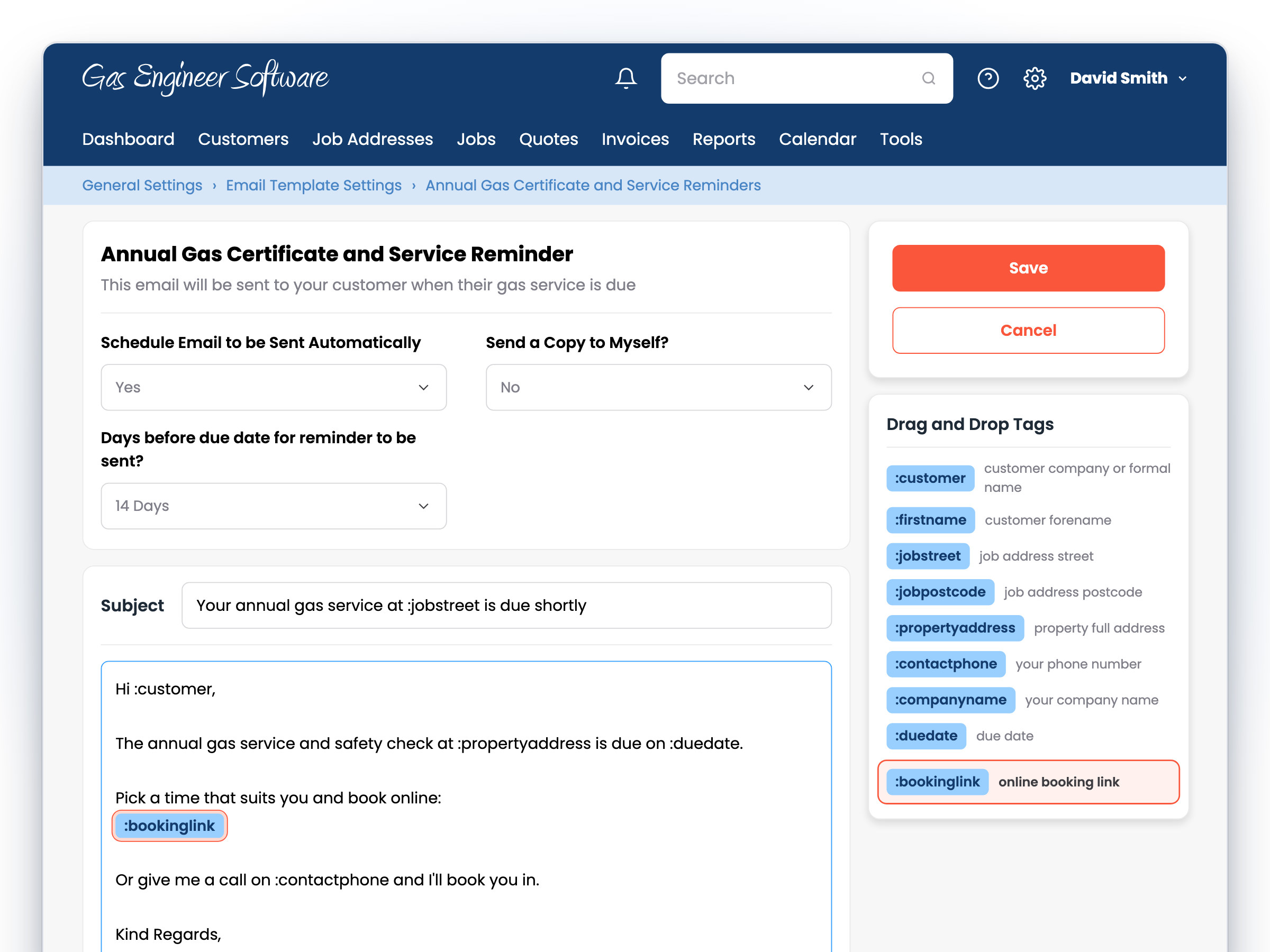
A lot of repeat work slips away because nobody got in touch when the service fell due. Make sure that reminders are being sent one way or another at least a few weeks in advance before the service due date. Our guide to setting up gas boiler service reminders walks through it.
3. Send a text as well as an email
Emails get missed, end up in spam or go to an address the customer stopped checking years ago. When we analysed 2.6 million service reminders, 29% of customers who got an SMS alongside the email booked in within 45 days, compared with 19% of those who were only emailed.
4. Let customers book themselves in
Every reminder that ends in “give us a ring” relies on the customer remembering to call, and on you being free to answer. Consider setting up an online booking system so you can add a link to your reminders. The customer picks a slot from the times you’ve made available, and the job goes straight into your diary.
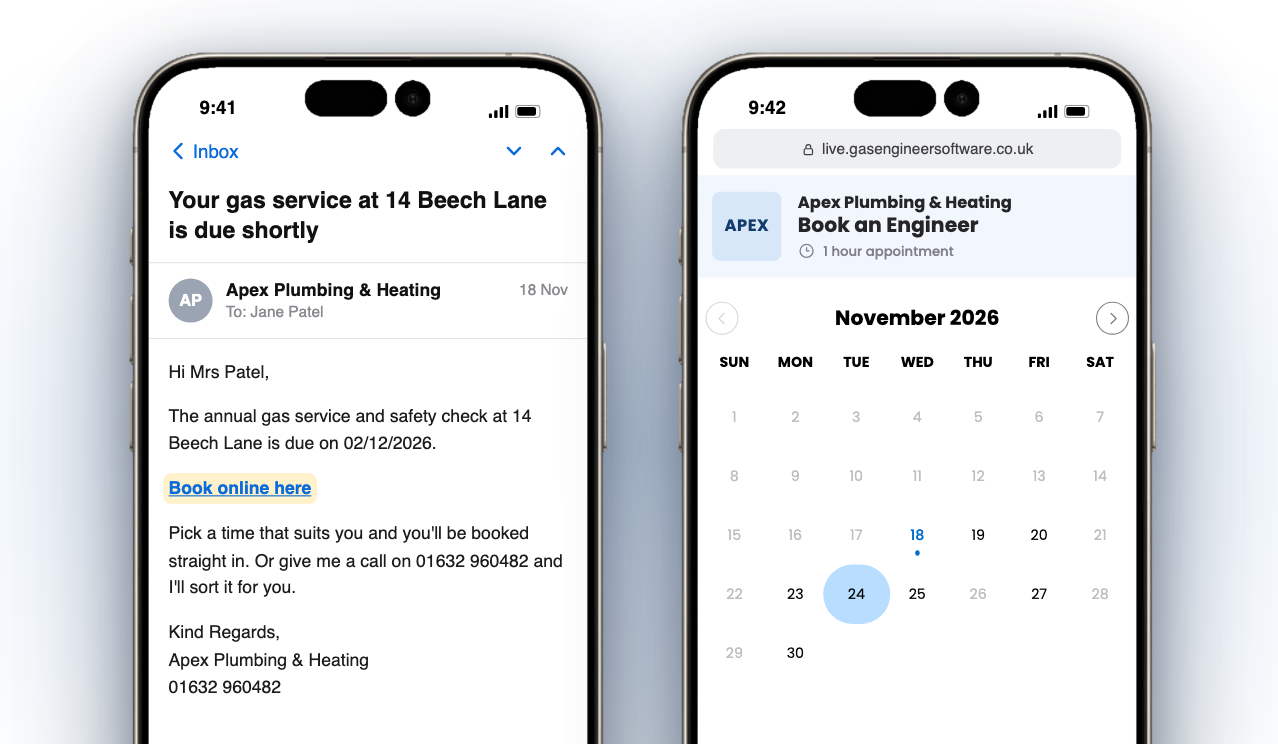
An email service reminder sent from GES, with the online booking link.
5. Turn one-off callouts into annual customers
A breakdown customer who’s never had a service from you is one of the easiest repeat customers to win. When you fix their boiler, add the appliance to your reminders so they hear from you when the service falls due. If they’re keen, offer a boiler service plan. Plans spread the cost for them and lock in the annual visit for you.
6. Look after landlords and letting agents
A landlord needs a gas safety check on every property every year, so one good relationship can bring you a whole portfolio of repeat CP12s. Our guide to working with letting agents covers how to win and keep that work.
What a higher repeat business rate does for your business
- More work, less chasing. Every returning customer is a job you didn’t have to win, and the more come back, the more your diary fills itself, even in quiet months.
- Less spent on marketing. You can still advertise, but to grow rather than to replace the customers you didn’t keep.
- More referrals. Regulars recommend you to neighbours, family and friends, and referred customers arrive already trusting you.
- Better reviews. Customers who’ve seen your work more than once are the easiest to ask for a review.
- Charge what you’re worth. Loyal customers are less likely to shop around on price, so you can hold your prices rather than match the cheapest quote.
- Quicker jobs. The boiler, the meter and last year’s work are already on the customer’s record, so there’s less guesswork on site.
- Reliable payers. Someone who’s paid promptly for three years will probably do it again.
New customers still matter
None of this means you should stop looking for new work. A young business needs new customers to build a base. Every business loses some customers over time, as people move house and landlords sell up. And if you want to grow your team, you’ll need more customers to keep them busy.
The aim is a business where new customers add to a solid base of repeat work rather than replace the customers you didn’t keep.
GES boiler service reminders fill your diary with repeat business
Email or SMS reminders with an online booking link, so customers come back year after year. Try it free for 14 days, no card needed.
Set up GES service reminders →