












































Best Accounting Software for Plumbers and Gas Engineers (UK 2026 Guide)
- 1. What plumbers and gas engineers actually need from accounting software
- 2. The top 3: Xero, QuickBooks and Sage
- 3. Xero
- 4. QuickBooks
- 5. Sage
- 6. Also worth a look: FreeAgent and FreshBooks
- 7. FreeAgent
- 8. FreshBooks
- 9. How to choose: a five-question check
- 10. Why integration matters more than the platform
- 11. FAQs
- 12. What accounting software does HMRC recommend?
- 13. Is QuickBooks good for tradies?
- 14. What’s the cheapest accounting software for plumbers?
- 15. Do I need accounting software if I’m a sole trader?
- 1. What plumbers and gas engineers actually need from accounting software
- 2. The top 3: Xero, QuickBooks and Sage
- 3. Xero
- 4. QuickBooks
- 5. Sage
- 6. Also worth a look: FreeAgent and FreshBooks
- 7. FreeAgent
- 8. FreshBooks
- 9. How to choose: a five-question check
- 10. Why integration matters more than the platform
- 11. FAQs
- 12. What accounting software does HMRC recommend?
- 13. Is QuickBooks good for tradies?
- 14. What’s the cheapest accounting software for plumbers?
- 15. Do I need accounting software if I’m a sole trader?
It’s the end of the quarter, the MTD deadline is closing in, and your “accounts” are a stack of receipts plus a spreadsheet that hasn’t been opened since February. Most sole traders and small heating firms have been there.
This guide compares the best accounting platforms for UK plumbers and gas engineers so you know which is right for you, plus the bit most guides skip: how well they talk to the job management software where your work actually lives.
What plumbers and gas engineers actually need from accounting software
Four things matter for a trade business:
- Making Tax Digital compliance and digital record-keeping. MTD for VAT is already mandatory if you’re VAT-registered. Whatever platform you pick must be on HMRC’s MTD-recognised list. All the major options are, as are all those listed in this guide. Learn more about how GES helps with MTD.
- Bank feeds. Automatic import from your business bank account, with rules that learn to categorise fuel, Screwfix runs and supplier accounts. The biggest single time-saver in any modern accounting platform.
- CIS handling. If you sub-contract or get sub-contracted, the software needs to handle Construction Industry Scheme deductions properly — and not every platform does, especially on the entry-level plans.
- Integration with your job management software. If your jobs, certificates and invoices already live in a job management app, the accounting platform needs to plug in cleanly. Anything less and you’re paying for software to re-type numbers you’ve already inputted.
The top 3: Xero, QuickBooks and Sage
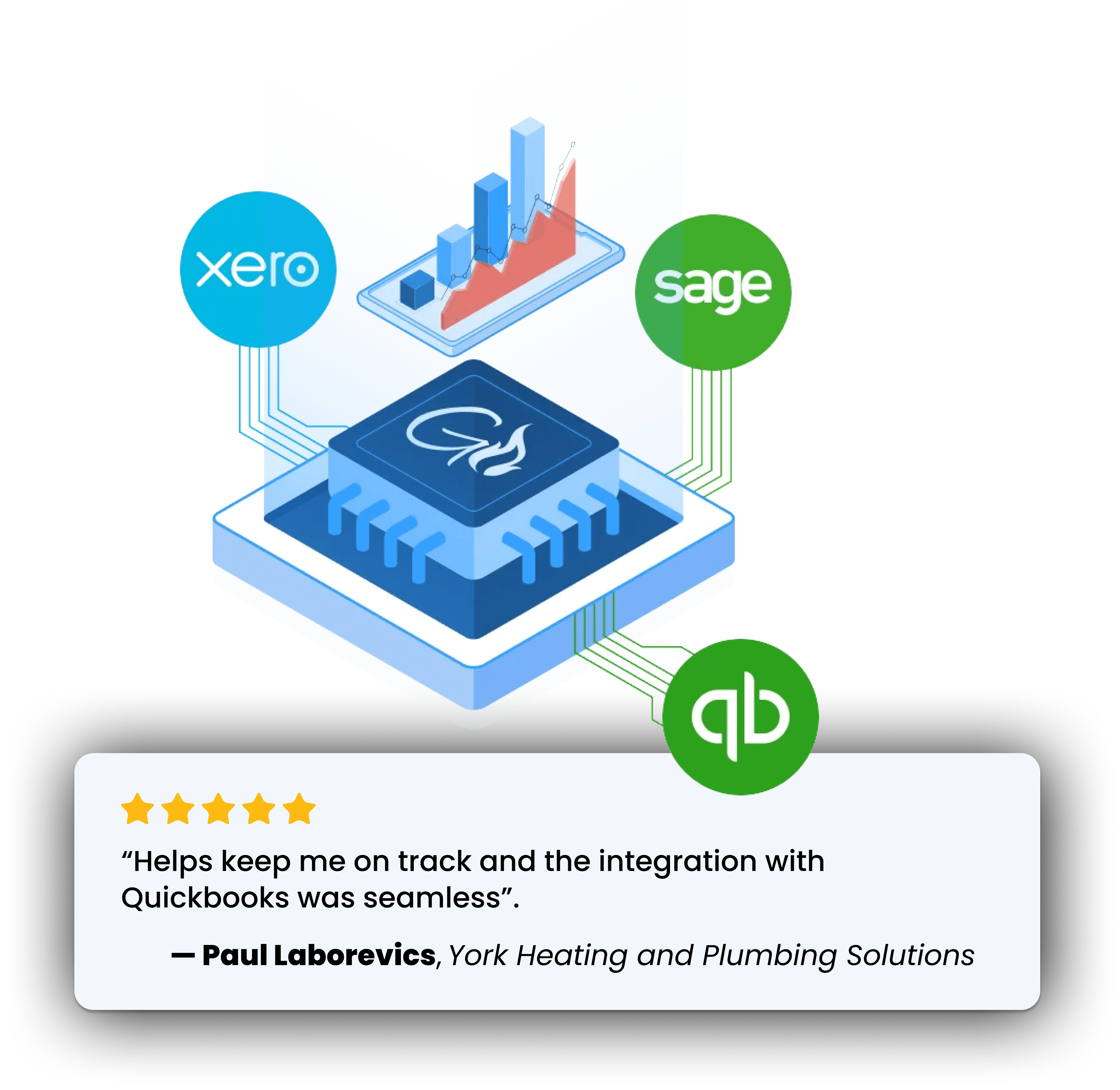
These three sit at the top for the same three reasons. They’re recognised by HMRC for MTD, they’re the platforms UK accountants and bookkeepers use day in, day out (so whichever you pick, your accountant will already know it), and they’re the platforms that integrate with leading job management systems like GES.

Xero
Best for: small-to-medium heating and plumbing teams who want clean software and strong bank feeds.
Pricing: starts from £16/month (Ignite plan). Current offer is 80% off your plan for your first 6 months. Checked June 2026.
Xero is slick to use day-to-day. The interface is clean, the mobile app is genuinely good, and the bank feed handling is best-in-class — once you’ve set up a few rules, most transactions categorise themselves. It’s also got the broadest app marketplace, which is why most job management platforms (Gas Engineer Software included) integrate with Xero.
CIS handling is built in. Payroll is a paid add-on. VAT submissions are direct to HMRC, and the audit trail is solid.
Summary: if your accountant uses Xero (and most modern UK accountants do) this is a great place to start. The integration story alone usually pays for itself within the first month.
QuickBooks
Best for: sole traders and small teams; the most common platform UK accountants encounter.
Pricing: starts from £10/month, but currently offering 90% off for 6 months (Sole Trader plan, regular price after introductory offer). Checked June 2026.
QuickBooks has the broadest range in the UK market — from a stripped-back Sole Trader plan that handles basic income and expenses, through Simple Start (VAT-ready), Essentials and Plus for growing teams. That makes a great option if you want to start cheap and scale into the software. The MTD for Income Tax workflow is well thought through, which matters if you’re a sole trader heading into the new rules.
The interface is familiar to most accountants, and the mobile app is solid. Bank feeds work well. Just remember that the Sole Trader plan doesn’t support VAT return submissions. So, if you’re VAT-registered, you need at least Simple Start.
CIS is supported on Essentials and above. Payroll is bolted on as an extra subscription.
Summary: if you’re a sole trader who wants the cheapest path into proper, MTD-compliant accounting — and the option to scale up without changing platform later — QuickBooks is hard to beat.

Sage
Best for: established heating and plumbing businesses, especially those running payroll, CIS and the full trade-business stack.
Pricing: Pricing upon request, typically starts from £18/month (Accounting Start). Checked June 2026.
Sage is very popular in the UK. If you’ve been in business for fifteen years, your accountant has almost certainly used Sage 50 at some point. The cloud version — Sage Accounting — has caught up well, and Sage Payroll is great for businesses with three or more engineers on the books.
Where it shines is at the “real business” end: multi-user access, multi-currency on the Plus plan, proper inventory if you need it (most plumbers and gas engineers don’t), and payroll that handles workplace pensions without drama. Where it lags is the polish of the everyday UX — it’s the most functional but the least pleasant to use of the three.
CIS is supported. MTD is fully covered.
Summary: if you’ve got employees, run payroll, and want one provider that does the lot, Sage earns its place at the top table. For a one-man-band, it’s overkill.
Also worth a look: FreeAgent and FreshBooks
These two are perfectly decent products. We’ve put them in a separate section because the wider trade ecosystem — job management apps, certificate apps, the integrations that actually save you time — doesn’t plug into them as deeply. That gap matters if your goal is to stop re-typing the same numbers in two places.
FreeAgent
Great for: sole traders and one-person limited companies who bank with NatWest, RBS, Ulster Bank or Mettle — they get FreeAgent free as part of a qualifying business account.
Pricing: starts from £19/month for sole traders, currently offering 50% off for your first six months. Checked June 2026. If you’re a NatWest, RBS, Ulster Bank or Mettle business customer, it’s included with your account at no extra cost.
FreeAgent is a nice piece of software for the right user. It’s designed around freelancers and contractors, the invoicing is clean, the Self Assessment tax timeline is a clever feature, and it covers MTD for both VAT and Income Tax. The included-with-banking offer is hard to argue with if you’re already a customer of those banks.
The catch for trade businesses is two-fold: CIS handling exists but is more limited than the top three, and trade-specific job management integrations are thin on the ground. If you’re running a one-person operation and you bank with NatWest, the maths are obvious. If you don’t, Xero or QuickBooks tend to make more sense.
FreshBooks
Great for: invoicing-first sole traders who care more about getting paid fast than about deep accounting features.
Pricing: starts from £16/month (Lite plan), currently offering 50% off for 3 months. Checked June 2026.
FreshBooks was built as invoicing software first and has bolted accounting on around it. The strength is the customer side — quotes, invoices, online payment links, automatic late-payment reminders. It’s pleasant to use and well-suited to engineers who hate the admin side and just want to chase what they’re owed. However, if you’re using job management software already, invoicing can be handled more cleanly there with deeper integration into your day-to-day workflows.
FreshBooks have some notable weaknesses for a trade business, though. The Lite plan caps you at 5 clients, which is too low for most plumbers within a few months of starting. There’s no native UK CIS support to speak of. And again, the trade software ecosystem doesn’t integrate with it the way it does with the top three.
How to choose: a five-question check
Ignore the marketing pages on each vendor’s site. Answer these five questions honestly and the platform usually picks itself.
- How many engineers, including you? One? QuickBooks Sole Trader or FreeAgent (if you bank with NatWest). Two to four? Xero or QuickBooks. Five-plus with payroll? Sage or Xero with the payroll add-on.
- Are you VAT-registered? If yes, you need at least QuickBooks Simple Start, Xero Ignite, Sage Accounting Start, or FreeAgent — the entry-level QuickBooks Sole Trader plan won’t submit VAT.
- Do you do CIS work? If yes, stay in the top three. CIS handling is deeper and better supported.
- Does your accountant already prefer one? If yes, that’s usually the right answer. The cost of switching your accountant outweighs the saving from switching platform.
- Does it talk to your job management software? This is the one most engineers don’t ask, and it costs them hours every week.
If you’re still trying to work out whether you should be a sole trader or a limited company before you pick any of this, start with our Sole Trader vs Limited Company guide and the wider Tax Guide for Heating and Plumbing Companies — the structure decision changes which features matter.
Why integration matters more than the platform
Most articles compare accounting software in isolation, as if the only thing the software talks to is your bank. For a trade business, that’s the wrong frame.
Your workflow likely includes customer calls, scheduling, work on the tools, issuing certificates and invoices, and so on. That invoice and payment ultimately needs to land in your accounts.
Doing this manually means a lot of duplicated work. By integrating your job management system with your accounting software, both can talk to each other and save you the hassle.
FAQs
What accounting software does HMRC recommend?
HMRC doesn’t recommend specific software. What it does maintain is a list of MTD-recognised software for VAT and for Income Tax Self Assessment. Xero, QuickBooks, Sage and FreeAgent all appear on those lists. FreshBooks is on the VAT list.
Is QuickBooks good for tradies?
Yes, for most UK plumbers and gas engineers, QuickBooks is a strong choice — particularly sole traders and small teams. The Sole Trader plan is the cheapest proper MTD-ready option from a major vendor, Simple Start handles VAT, and CIS support is included from Essentials upwards. It also integrates with the trade job management platforms that matter.
What’s the cheapest accounting software for plumbers?
If you bank with NatWest, RBS, Ulster Bank or Mettle, the cheapest option is FreeAgent — it’s included free with a qualifying business account. However, QuickBooks, Sage, and Xero all offer competitive plans alongside integrations with major job management systems like GES.
Do I need accounting software if I’m a sole trader?
More than likely. From April 2026, MTD for Income Tax Self Assessment has been phased in for sole traders with qualifying income above £50,000 — which means you’ll need MTD-compatible software to keep records and submit quarterly updates. This limit is lowering in future years.