











































Best Plumbing Job Management Software UK: A 2026 Buyer’s Guide
- 1. What plumbing job management software actually does
- 2. What to look for when choosing plumbing software
- 3. Mobile-first design
- 4. UK gas certificates
- 5. Scheduling that suits how you actually work
- 6. Quoting and invoicing in the field
- 7. Accounting integration
- 8. UK-based support
- 9. The shortlist: 7 options worth considering in 2026
- 10. 1. Gas Engineer Software (GES)
- 11. 2. Powered Now
- 12. 3. Tradify
- 13. 4. Commusoft
- 14. 5. Joblogic
- 15. 6. ServiceM8
- 16. 7. Simpro
- 17. Next steps
- 18. Frequently asked questions
- 19. What is the best job management software for plumbers in the UK?
- 20. What CRM do plumbers use?
- 21. Is there free plumbing job management software?
- 22. Does plumbing software work offline?
- 23. How long does it take to switch plumbing software?
- 1. What plumbing job management software actually does
- 2. What to look for when choosing plumbing software
- 3. Mobile-first design
- 4. UK gas certificates
- 5. Scheduling that suits how you actually work
- 6. Quoting and invoicing in the field
- 7. Accounting integration
- 8. UK-based support
- 9. The shortlist: 7 options worth considering in 2026
- 10. 1. Gas Engineer Software (GES)
- 11. 2. Powered Now
- 12. 3. Tradify
- 13. 4. Commusoft
- 14. 5. Joblogic
- 15. 6. ServiceM8
- 16. 7. Simpro
- 17. Next steps
- 18. Frequently asked questions
- 19. What is the best job management software for plumbers in the UK?
- 20. What CRM do plumbers use?
- 21. Is there free plumbing job management software?
- 22. Does plumbing software work offline?
- 23. How long does it take to switch plumbing software?
You’re between jobs in the van, scrolling through WhatsApp to find the boiler model you fitted at number 47, while three other customers text about appointments. For most plumbing business owners, this is everyday life.
Plumbing job management software can help eliminate much of the stress and get you back to the real work — but there’s several different options available.
Picking the right one depends on how your business works and what it needs, so we’ve rounded up the best options for UK plumbers in 2026.
What plumbing job management software actually does
Plumbing job management software replaces the paper diary, the WhatsApp scheduling, and the endless admin with one system. Job in, job done, invoice paid — without anything getting dropped.
The core jobs it handles:
- Scheduling and dispatch — booking work into engineers’ diaries and routing them efficiently
- Customer database — every customer’s history, appliances, and certificates in one place
- Quoting and invoicing — quotes from the van, invoices issued before you’ve left the driveway
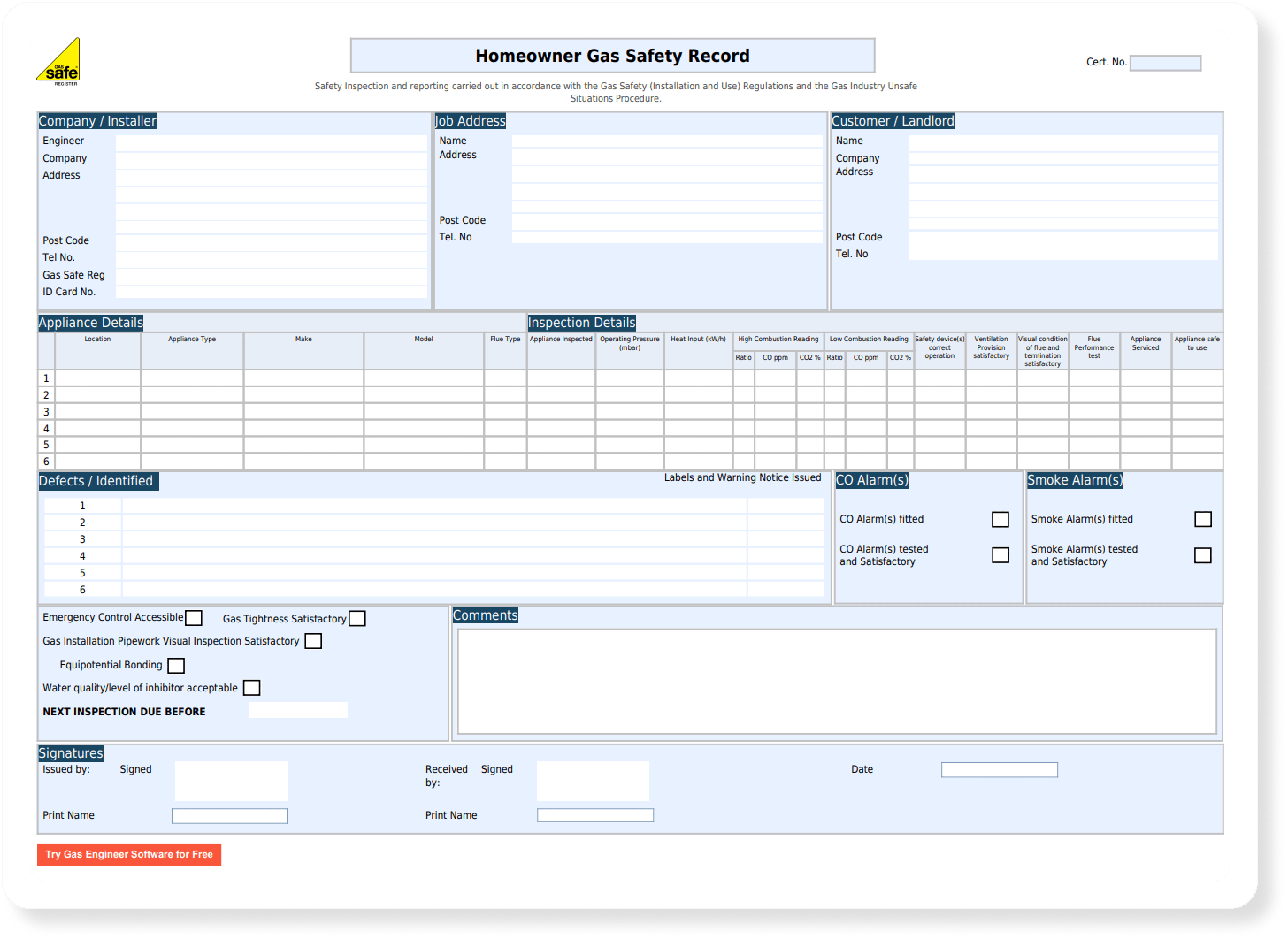
- Certificates and compliance — gas safety records, landlord checks, and service reports completed digitally
- Job tracking — where each job is, what’s been done, what’s outstanding
- Payment collection — card payments on the day rather than chasing for weeks
- Reporting — what’s profitable, who’s productive, what’s coming up
Most platforms sync with accounting tools like Xero, QuickBooks and Sage, so the same job doesn’t get typed in twice and you can keep your books organised.
What to look for when choosing plumbing software
Before comparing names, work out what matters for your specific setup. A sole trader’s needs are different from a 20-plumber business with office staff.
Mobile-first design
Plumbers work on tools, not at desks. If the software is awkward on a phone, it won’t get used. Check the mobile app reviews on the App Store and Google Play before committing — that’s where the truth comes out.
UK gas certificates
If you or your engineers carry a Gas Safe card, the software needs to handle gas safety certificates — CP12s, Warning Notices, Installation Records, Purging records. Generic plumbing apps from overseas markets often miss this entirely, leaving you with a separate compliance workflow that defeats the point of going digital in the first place.
Scheduling that suits how you actually work
Drag-and-drop calendar views, route optimisation, connected with job details. Decent scheduling software updates everywhere instantly, so your engineers see today’s jobs the moment the office adds them.
Quoting and invoicing in the field
The faster you raise an invoice, the faster you get paid. Look for quote-to-invoice conversion, automated reminders for overdue payments, and mobile invoicing.
Accounting integration
If your bookkeeper uses Xero and your plumbing software doesn’t talk to it, expect double data entry forever. A native integration with your accounting software matters more than people realise.
UK-based support
Self-explanatory. If you’re going to run your business on software, you need to know you can count on it and get real help when you need it.
The shortlist: 7 options worth considering in 2026
These are the platforms that consistently come up when UK plumbing and heating businesses compare options. Each one has a different feature set and price profile.
1. Gas Engineer Software (GES)
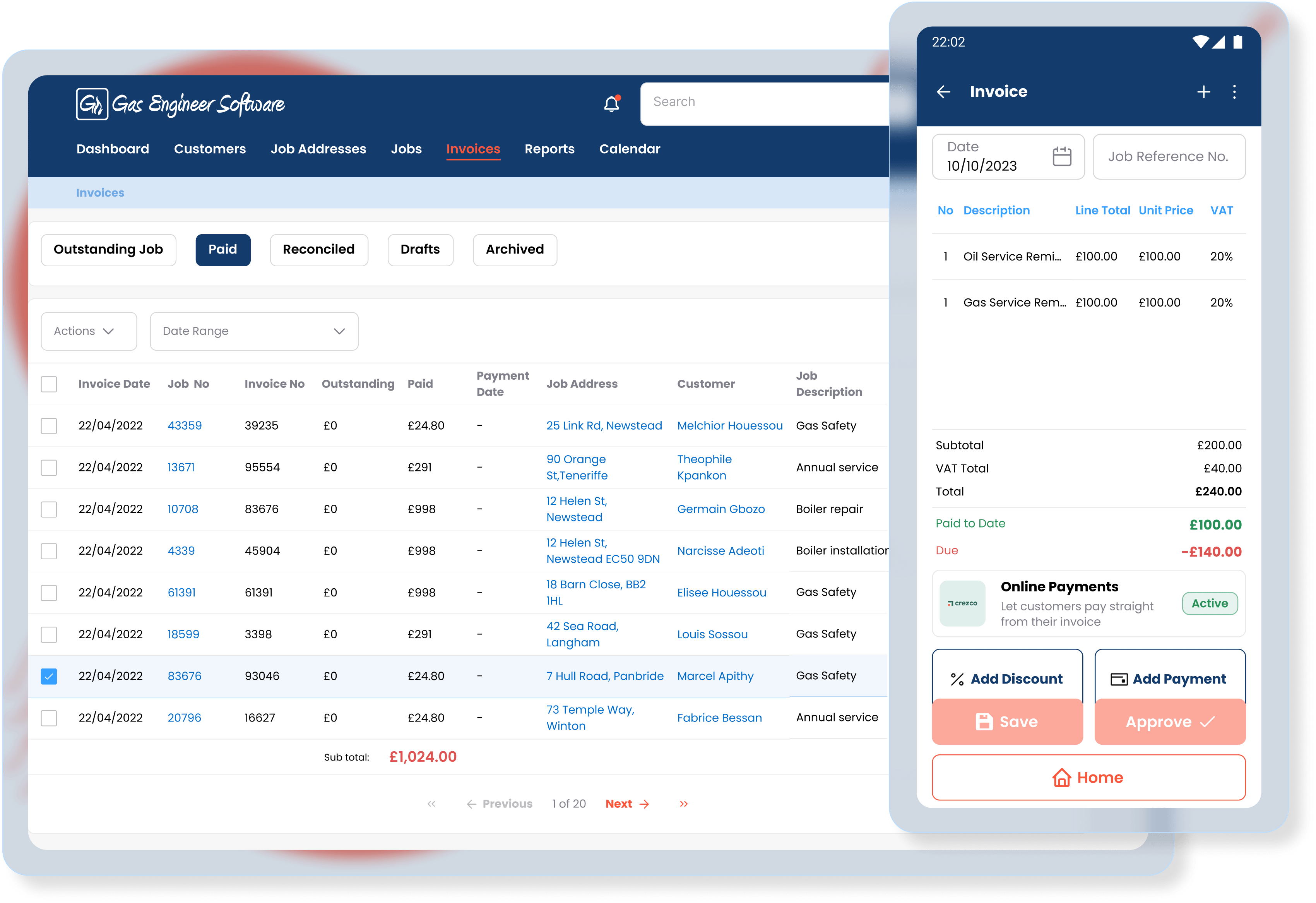
Gas Engineer Software is built specifically for UK heating and plumbing professionals, and offers a reliable, easy-to-use app and web portal pair to help you run your business. It’s the best option for sole traders and small to medium heating and plumbing teams who need digital certificates and straightforward job management without setup pain.
The core job and customer management system keeps all information tied to a specific customer, job address, and job, so all communications, certificates, records, notes, and photos are kept organised.
The scheduling works like a shared calendar that updates everywhere instantly (even to your external calendar), so you see today’s jobs the moment you add them. Invoicing converts straight from a quote, and integrations cover Xero, QuickBooks and Sage so you can connect to your accounting platform and avoid double data entry.
Key features: Digital UK heating & plumbing certificates, connected CRM & scheduling, quoting and invoicing, easy payment links, accounting integrations, automated service & payment reminders, offline mode, and UK-based human support team.
Strengths: Purpose-built as an all-in-one app for UK heating and plumbing professionals, simple mobile experience, UK-based, no setup fees.
Weaknesses: Gas Engineer Software’s focus on heating & plumbing means it can’t be an all-in-one software for larger, multi-trade businesses.
Pricing: 14-day free trial into paid monthly/yearly subscriptions. Click for updated pricing info.
2. Powered Now
Powered Now is a UK-built job management platform aimed at small trade businesses — plumbers, builders, electricians and heating engineers. The standout features are a customer portal to book appointments and a full job management flow with quoting, invoicing, timesheets, and MTD accounting compliance.
Because it serves so many trades, the gas-specific workflows aren’t as polished as platforms built purely for heating and plumbing, and some core features (live team tracking, forms & certificates, reminders) sit in higher tiers. Compare Powered Now with Gas Engineer Software.
Key features: Job and diary management, quoting and invoicing, ~100 industry forms and certificates, offline mode, MTD-ready, live team tracking, multi-device sync across iOS/Android/Mac/Windows.
Strengths: UK-built and UK-supported, works offline, broad multi-trade forms library, cross-platform.
Weaknesses: Multi-trade focus means gas and heating workflows aren’t as specialised, some features behind higher-tier plans.
Pricing: 14-day free trial into paid monthly/yearly subscriptions.
3. Tradify
Tradify is a New Zealand-built job management platform that’s pushed hard into the UK market. It’s well-regarded for its mobile-first design, fast on-site quoting, and clean modern interface. Tradify also features a custom website builder, subcontractor management, and a set of handy AI tools to help with tasks like scanning invoices.
However, UK heating and plumbing businesses may find the lack of offline access for the mobile app tricky in some locations, as well as finding an affordable plan that isn’t loaded with features aimed at other trades. Compare Tradify with Gas Engineer Software.
Key features: Mobile-first quoting and invoicing, real-time team scheduling, customer database, subcontractor management, time and materials tracking, instant website generator.
Strengths: Polished mobile experience, fast on-site quoting, modern UI, broad integrations, full-feature free trial.
Weaknesses: No offline access for the mobile app, no saved appliance details, built for multiple trades rather than heating and plumbing specifically.
Pricing: 14-day free trial into paid monthly/yearly subscriptions.
4. Commusoft
Commusoft has been in the UK trades market for years and ships a deep feature set covering inventory management, fleet tracking, planned maintenance contracts and customer portals. Their AI:den+ feature (announced 2025, rolling out through 2026) converts engineer audio recordings into written job notes.
With this extensive feature set comes additional complexity. There’s no self-serve free trial, onboarding can take weeks, and pricing reflects the platform’s enterprise positioning — implementation cost and timeline are notably higher than mobile-first alternatives.
Key features: Inventory management, fleet tracking, planned maintenance scheduling, customer portal, parts and stock management, AI audio-to-notes (AI:den+).
Strengths: Deep feature set, mature platform, customer-facing portal.
Weaknesses: Steeper learning curve, no self-serve free trial, longer onboarding, higher entry price.
Pricing: Custom quotes — pitched at the higher end of the market.
5. Joblogic
Joblogic is another UK-grown platform with a deep feature set, gas compliance workflows, and support for facilities management contracts. It has more of a pipeline and asset-focus feel than service-led platforms, with asset registers and audit trails built around recurring service contracts.
Key features: UK gas compliance forms, asset management, contract pipeline view, audit trails, FM workflows.
Strengths: UK-built, gas compliance built in, asset management for commercial clients.
Weaknesses: Heavier interface, complex range of features, pricing on the upper end, longer onboarding.
Pricing: Custom quotes, tiered by feature set.
6. ServiceM8
ServiceM8 is Australian software that’s popular with UK plumbers thanks to its mobile-first design. Scheduling, quotes, invoices, photo capture and on-site card payments all work cleanly on the mobile app.
ServiceM8 doesn’t issue UK-specific gas safety certificates out of the box, so anyone certifying boilers needs to purchase separate add-ons for the paperwork — worth knowing before committing.
Key features: Drag-and-drop scheduling, quote-to-invoice conversion, photo capture per job, on-site card payments, mobile-first design.
Strengths: Polished mobile app, simple onboarding, pay-as-you-go pricing model.
Weaknesses: No native UK gas certificates, no phone-based support, only ServiceM8 Lite (limited functionality) for Android users.
Pricing: Pay-as-you-go subscription plus per-job charges. Confirm current rates with the vendor.
7. Simpro
Simpro is aimed at the bigger end of the market — mechanical contractors, multi-engineer commercial firms and businesses with significant project-based work alongside service. A great option if your business fits this description, but the estimating, project management and reporting capabilities go well beyond what a typical domestic plumbing business needs, and certain features are add-on to the subscription.
Key features: Project management with multiple cost centres, advanced estimating, enterprise reporting, inventory and stock control, time and materials tracking.
Strengths: Powerful estimating, project management, enterprise-grade reporting.
Weaknesses: Overkill for service-led businesses, higher price point, longer implementation.
Pricing: Custom quotes, premium tier.
Next steps
Most plumbing business owners realise they’ve outgrown their current setup not because something dramatic broke, but because the small things keep adding up — a missed service, a job booked twice, an invoice forgotten for three weeks. The right plumbing job management software fixes those small things compoundingly.
If your business is heating and plumbing focused and you want to see what’s possible without committing, try Gas Engineer Software free — full features, no card required.
Frequently asked questions
What is the best job management software for plumbers in the UK?
There isn’t a single best — it depends on your business size and the type of work you do. For UK heating and plumbing specialists from sole traders through mid-sized firms with office staff, Gas Engineer Software is purpose-built for the job: digital certificates, real-time scheduling, and accounting integrations are all baked in. For commercial mechanical contractors with significant project work and multi-cost-centre estimating needs, Simpro is built for that scale. Commusoft and Joblogic add deeper inventory and asset management features for businesses that specifically prioritise those.
What CRM do plumbers use?
Most UK plumbing businesses use job management platforms rather than standalone CRMs. The customer database, job history and communication tracking are baked into the same tool — which is more practical than running a separate CRM alongside.
Is there free plumbing job management software?
Free options exist but they tend to cap features quickly — limited users, no certificate handling, no integrations. For a one-engineer operation it can work as a starting point. For anything more, the cost of a paid platform is usually recovered within weeks through faster invoicing and less admin time.
Does plumbing software work offline?
The better mobile apps cache data locally so engineers can complete jobs and issue certificates in customer properties with no signal, then sync when they’re back on connection. Check this specifically if you work in rural areas or basement plant rooms.
How long does it take to switch plumbing software?
Anywhere from a day to several weeks depending on the platform and how much customer data you’re migrating. Simpler platforms can be live by lunchtime. Larger systems with custom workflows can take a month or more. Ask for a clear onboarding timeline in writing before signing anything.